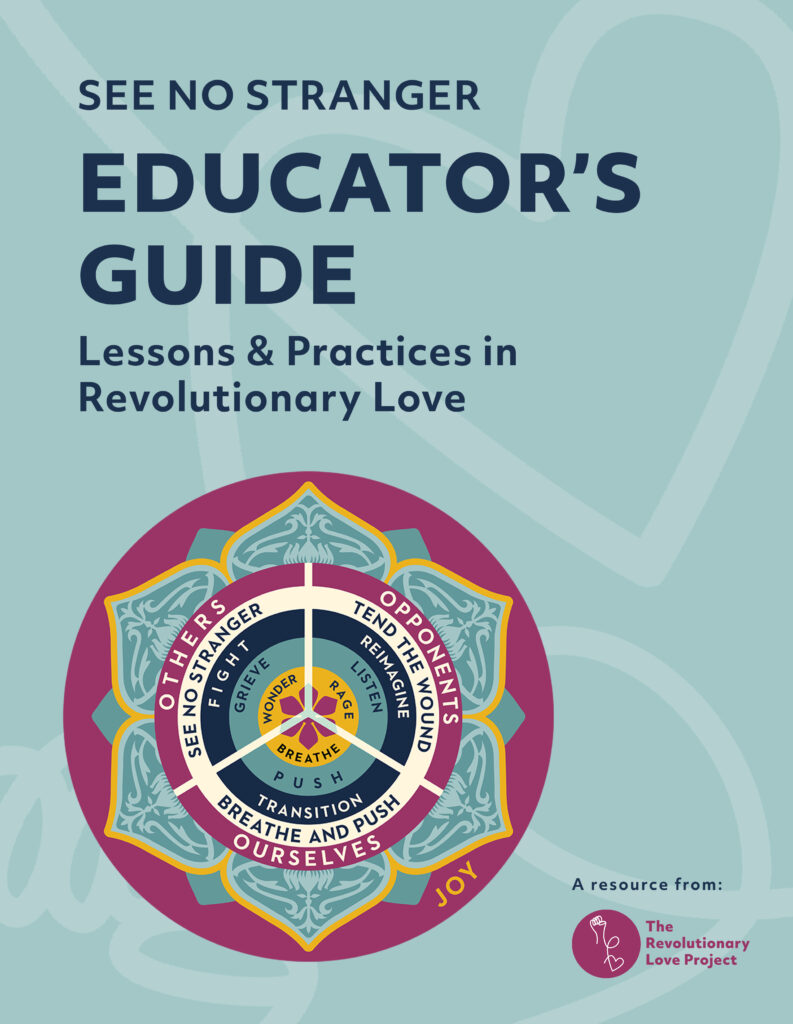
You can use the Revolutionary Love Compass as a tool in all arenas in your life.

We have identified ten core practices of revolutionary love, backed by research and infused with ancestral wisdom.

Revolutionary Love is the choice to labor for others, our opponents, and ourselves to transform the world around us. It begins with wonder: “You are a part of me I do not yet know.” Think of these practices as points on a compass.

Point the compass toward whomever you want to practice loving— another, an opponent, or yourself.

Click to listen to Revolutionary Love founder Valarie lead you through the compass in this 9-minute audio track.

Educators & Community Members

Watch an introduction to the Compass

Watch an introduction to the Compass

Love for Others: See No Stranger

Seeing no stranger begins in wonder. It is to look upon the face of anyone and choose to say: You are a part of me I do not yet know. Wonder is the wellspring for love. Who we wonder about determines whose stories we hear and whose joy and pain we share. Those we grieve with, those we sit with and weep with, are ultimately those we organize with and advocate for. When a critical mass of people come together to wonder about one another, grieve with one another, and fight with and for one another, we begin to build the solidarity needed for collective liberation and transformation—a solidarity rooted in love.

Wonder

To wonder is to cultivate a sense of awe and openness to others’ thoughts and experiences, their pain, their wants and needs. It is to look upon the face of anyone or anything and say: You are a part of me I do not yet know. Wonder is an orientation to humility: recognizing that others are as complex and infinite to themselves as we are to ourselves. Wondering about a person gives us information for how to love them. You can practice wonder for all others – animals, trees, living beings, and the earth. Wonder gives you information for how to care for them. Wonder is the wellspring of love.

Grieve

To grieve with others is to share their pain, without trying to minimize or erase it. Grieving with others requires a willingness to be transformed by their experiences, especially those who have suffered trauma and violence. Grieving collectively and in community gives us the information to build solidarity, to fight for justice, and even to share in one another’s joy.

Fight

To fight is to choose to protect those in harm’s way. To fight with revolutionary love is to fight against injustice alongside those most impacted by harm, in a way that preserves our opponents’ humanity as well as our own. When we fight for those outside our immediate circle, our love becomes revolutionary.

Love for Opponents: Tend the Wound

An opponent is any person whose beliefs, words, or actions causes violence, injustice, or harm. The word “enemy” implies permanence, but “opponent” is fluid. We have a range of opponents at any given time, distant and near. Even the people closest to us can become our opponents for a moment. It is daring to put all these people in one big category, but it is useful, for whether our opponents are political or personal, persistent or fleeting, we can practice tending the wound—ours, and if it is safe, theirs. We can rage in safe containers to process our pain, listen to understand the contexts that enable our opponents to cause harm, and use that information to reimagine cultures and institutions that protect dignity for all of us. Tending the wound is not only moral but strategic: It is the labor of remaking the world.

Rage

To rage is to express our body’s most fiery energy, it is to tap into our body’s power to protect ourselves and others. To rage is to honor and tend to our own pain so that trauma does not hijack our ability to see another’s humanity. When we listen deeply to our rage against injustice, we gain the information and energy we need to transform the world.

Listen

To listen to our opponents is to seek to understand them–not to change them, or persuade them, not to compromise with them, or legitimize them. Listening to our opponents preserves their humanity—and our own. Listening is not just a moral act; it is strategic. Listening enables us to fight in smarter ways for justice—not only to remove bad actors from power but to change the cultures that radicalize them. This is how listening to our opponents becomes a powerful act of revolutionary love.

Reimagine

To reimagine is to explore a vision of a relationship, community, and world where we all flourish. Reimagining means that we’re doing more than resisting our opponents. We are looking at the cultures that radicalize them and institutions that authorize them. This is the moment to declare what is obsolete, what can be reformed, and what must be reimagined. Reimagining focuses us not just on what we are fighting against, but the future that we are fighting for.

Love for Ourselves: Breathe & Push

Loving ourselves is a feminist intervention: It is choosing to care for our own bodies and lives as a priority. In all of our various labors—making a life, raising a family, or building a movement—we can care for ourselves by remembering the wisdom of the midwife: breathe and push. We can breathe to draw energy and power into our bodies and let joy in. We can push through fear and pain to become our best selves, including through healing, forgiveness, and reconciliation. And in the most convulsive moments of our lives, we can summon our deepest wisdom and find the bravery to transition, undertaking the fiery and life-giving labor of moving from one reality into another. Laboring in love is how we birth the world to come.

Breathe

Breathing is the practice of taking conscious deep breaths. It is also the act of creating space in our lives to slow down and care for our bodies, minds, and spirits. Breathing in community is how we sustain ourselves and our labors for justice — and let joy in. Choosing to love ourselves, by breathing deeply each day, is a political intervention. Taking the time to breathe—literally and metaphorically—is a way to assert that our bodies are worthy and beloved. Loving our bodies is the first and primal act of loving ourselves. This is how breathing becomes an act of revolutionary love.

Push

To push is to choose to enter grief, rage, or trauma as part of a healing process. Pushing requires us to discern the right times to breathe and rest, and the right time to push through painful sensations, emotions, and thoughts to birth new possibilities in ourselves and others.

Transition

Transition is both a noun and a verb. Transition is the fiery process that is required to move from one reality into another. To transition is to summon the courage to stay in the labors of love and justice, even when we want to give up. It requires us to draw upon collective wisdom to birth something new together.

Joy

Joy

Joy is the core practice that sustains all others. To let in joy is to give our senses over to what is beautiful, delightful, pleasurable, or wondrous in the present moment. Joy is the gift of love. Joy returns us to everything good and beautiful and worth fighting for. It gives us energy for the long labor.

Resources

Educators & Community Members

Are you ready to teach revolutionary love in your classroom? Lead a series in your organization or house of worship? Or make love the ethic of your campus or community? We are calling all educators — teachers, professors, community leaders, faith leaders, youth workers, and parents! We created this Educator’s Guide for you — a comprehensive curriculum backed by research, animated through stories, and infused with wisdom.


What’s Inside?

  • 10 original lesson plans on each of the ten practices of revolutionary love, plus an introductory lesson.
  • A comprehensive toolkit for educators with 120+ pages of content, including learning goals, individual and group activities, discussion questions, and additional resources for deeper exploration.
  • Designed for high schools, colleges, and communities. Can be adapted for younger ages.
  • Packed with powerful narratives, theories, and practices from writers, scholars, and practitioners, including Grace Lee Boggs, Tarana Burke, bell hooks, Ibram X. Kendi, and more.
  • Timely case studies including movements such as Black Lives Matter, Disability Justice, and the #MeToo movement.
  • Flexible structure to teach as a whole course or use lessons as part of existing courses.
  • Independent learners can explore the lessons sequentially or dive into lessons as desired.
  • A companion to SEE NO STRANGER by Valarie Kaur. Lessons correspond with book chapters.


Fill out the form below to receive the Educator’s Guide in your inbox today.

"*" indicates required fields

Name*
 

The Educator’s Guide was written by Dr. Melissa Canlas, Director of Education at the Revolutionary Love Project with support from our research scholars. It is based on the work of Valarie Kaur and her book See No Stranger: A Memoir and Manifesto of Revolutionary Love. Kaur produced and co-edited this guide.

We are happy to provide this guide to support revolutionary love in classrooms and communities. We offer this guide on a sliding scale (pay what you can), beginning at $0. We recommend a donation of $87 for this labor, led by women of color. We welcome anything you are able to offer to support our education work.

WIll you make a donation?*

Additional learnings

The People's Inauguration

The Educator's Guide to Revolutionary Love

America is in transition. We are coming together to create a society where we are all free.

Early Childhood Education

We are bringing the practices of Revolutionary Love alive for young children.

Remember 9/11

Understanding 9/11

The 9/11 learning hub is a place to learn about the decades-long impact of 9/11 on people of color.

Scroll to Top

We are reclaiming Love as a force for justice.

Let’s keep building together.

**All donations are tax deductible.**